
Master the Drawdown Trap to Pass Prop Firm Evaluations and Keep Your Funded Account (Copy)
The modern trading landscape has shifted dramatically. Gone are the days when you needed a six-figure bank account to trade futures seriously. The rise of proprietary trading firms has democratized access to capital, allowing skilled retail traders to manage accounts ranging from $50,000 to $300,000 without risking their own life savings. It is arguably the greatest opportunity in the history of retail trading. However, this accessibility comes with a steep hidden cost: the illusion of ease. The barriers to entry are low, but the barriers to success remain incredibly high.
Most aspiring traders dive into evaluations with dreams of massive payouts, only to find themselves trapped in a cycle of failed challenges and reset fees. The statistics are sobering; a vast majority of applicants never reach the funded stage, and many who do lose their accounts shortly after. The reason isn't usually a lack of ambition or even a lack of basic market knowledge. The primary culprit is a lack of structural consistency and the psychological warfare involved in navigating volatile markets like the Nasdaq-100 (NQ) and the S&P 500 (ES). To bridge the gap between paying for evaluations and receiving payouts, you must stop treating trading like a high-stakes game and start operating with the precision of a business.
The Mathematical Reality of the "Drawdown Trap"
The first step to passing an evaluation is understanding what you are actually trading. When you sign up for a "$50,000 account," you do not have $50,000 of breathing room. You have the distance between your starting balance and the maximum drawdown limit—typically around $2,000 to $2,500. This is your actual capital. Every decision you make must be calibrated to this reality.
Traders fail because they size their positions for a $50,000 account rather than a $2,500 account. A few emotional trades or a string of bad luck can wipe out that buffer in minutes if you are guessing at entries or chasing price action. This is where the psychological pressure mounts. When you are trading with a thin margin for error, hesitation and second-guessing become your worst enemies. You might exit a winning trade too early out of fear, or hold a losing trade too long hoping it will reverse. To survive the evaluation phase, you need a system that removes this emotional weight. You need a strategy that defines your risk to the tick before you even enter the market.
Why NQ and ES Are the Prop Trader’s Arena
For those aiming to get funded, the E-mini S&P 500 (ES) and the E-mini Nasdaq-100 (NQ) are the battlegrounds of choice. These futures contracts offer deep liquidity, allowing you to enter and exit positions instantly without slippage, which is critical when managing tight risk parameters.
The ES is known for its technical respectability. It tends to move in a more measured, structural way, honoring support and resistance levels with high fidelity. It is the preferred instrument for traders who want a smoother, slightly slower-paced environment.
The NQ, on the other hand, is the sprinter. It is volatile, fast, and capable of massive intraday moves. For a disciplined trader, NQ offers the ability to hit profit targets quickly. For the undisciplined, it is a quick way to hit a daily loss limit.
The challenge lies in the fact that these markets are dominated by institutional algorithms. Trying to "feel" your way through an NQ session is a recipe for disaster. The market moves too fast for manual processing of every variable. To capture the volatility of NQ or the structure of ES without getting churned up, you need a navigational tool that cuts through the noise and identifies high-probability setups objectively.
Precision Over Instinct: The Quantum Navigator Edge
This is the pivotal moment where the amateur separates from the professional. The professional does not wake up and ask, "What do I feel the market will do today?" They ask, "What does my system say?" Eliminating guesswork is the single most effective way to protect your psychology and your capital.
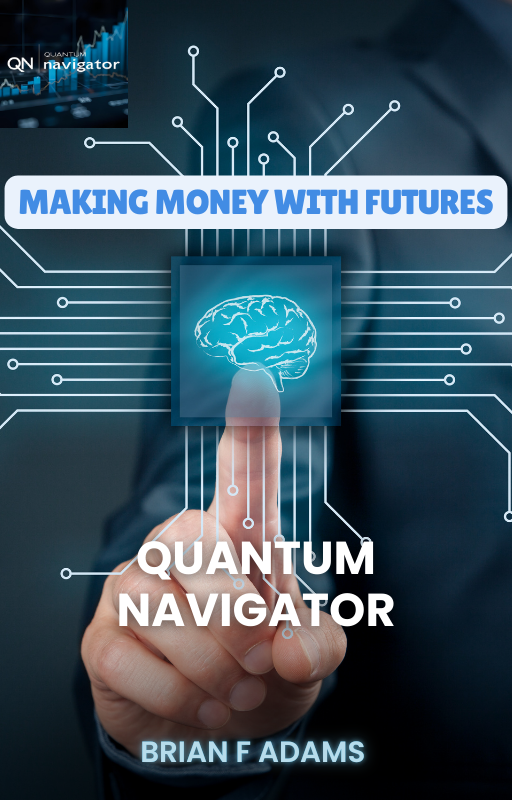
Quantum Navigator was developed to fill this exact void. It is not just a signal service; it is a comprehensive strategic framework designed specifically for the complexities of the Nasdaq and S&P futures markets. Built by a veteran futures trader, it addresses the core problem of evaluation failure: inconsistency. By leveraging an advanced, AI-driven methodology, Quantum Navigator identifies high-value trade opportunities with clarity, removing the ambiguity that leads to hesitation and bad entries.
When you are in a prop firm evaluation, you cannot afford to wonder if a setup is valid. You need to know. Quantum Navigator provides that certainty. It empowers you to execute trades based on a proven edge rather than a hunch. The system is designed to align with the risk management rules of prop firms, focusing on securing consistent profits while protecting that critical drawdown buffer. Beyond the signals, the package includes a training eBook and instructional videos, ensuring you understand the why behind the moves. This turns you from a passive signal-follower into an educated, competent futures trader.
A Blueprint for Evaluation Success
Once you have a reliable tool like Quantum Navigator to handle the strategy, you must wrap it in a disciplined daily routine. Passing an evaluation is a marathon of consistency, not a sprint of massive windfalls.
Here is a structured approach to clearing the hurdle:
- Respect the Daily Loss Limit: This is the only rule that matters. If you hit your daily max loss, walk away immediately. There is always tomorrow, but only if you don't blow the account today.
- Trade the Setup, Not the P&L: Stop looking at your account balance in dollar terms. Focus entirely on executing the strategy. If Quantum Navigator signals a short on NQ, execute the short according to the plan. Let the math play out.
- One Session, One Focus: Do not try to trade the Asian session, the London open, and the New York close all in one day. Pick the time of day when volume is highest (usually the US morning session) and apply your edge then.
- Secure the Bag: Prop firms reward consistency. If you hit your daily profit goal, stop trading. Greed is the primary reason traders fail after being up on the day.
- Review and Refine: Use the educational resources provided with your strategy to review your trades. Did you follow the plan? Did you hesitate? Continuous learning is what keeps you funded once you pass.
Conclusion
The path to becoming a funded trader is open to anyone, but it is walked successfully only by those who treat it with respect. The market is an unforgiving teacher, and the tuition is paid in lost evaluations and shattered confidence. You can choose to pay that price, or you can choose to equip yourself with the tools that tilt the odds in your favor.
By focusing on the right markets—NQ and ES—and utilizing a proven, no-guesswork solution like Quantum Navigator, you transform trading from a game of chance into a professional endeavor. The goal is not just to pass a test; it is to build a career where you manage substantial capital with confidence. The liquidity is there, the opportunity is real, and with the right guidance, the funding is within reach.
Take the next step in professionalizing your futures trading journey and see how a structured approach can change your results.
Discover the strategy that is helping traders navigate the futures market with precision.